Driving D2C eCommerce Growth with ROAS-Centric Performance Marketing
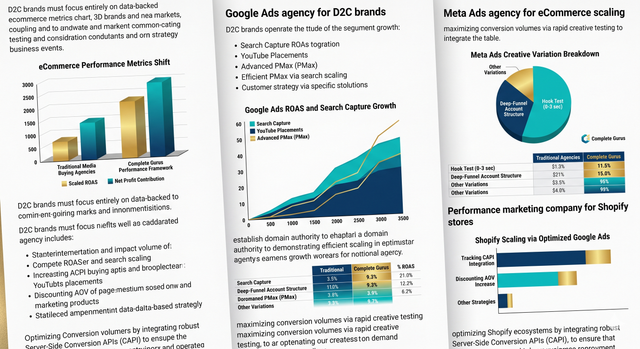
For modern direct-to-consumer brands, growth depends on far more than running ads and waiting for sales. Strong results come from a disciplined performance system where every campaign, product feed, creative asset, audience signal and landing experience is measured against profitability. Companies exploring the Best Google Ads agency for D2C brands, the Top-rated Meta Ads agency for eCommerce scaling or a Performance marketing company for Shopify stores typically aim for one goal: scalable profitability. In a competitive market, revenue alone is not enough. A business can boost sales yet lose margin due to higher acquisition costs, poor tracking or inefficient campaign setup. For this reason, effective eCommerce scaling relies on a data-focused model measuring ROAS, CAC, AOV, repeat behaviour and net profitability.
Understanding ROAS for D2C Success
Return on Ad Spend is a key performance indicator for D2C brands because it measures how well spend translates into sales. However, strong ROAS should not be considered alone. One campaign may deliver high returns but struggle to scale, while another with lower ROAS may attract more valuable long-term buyers. The real goal is profitable growth, where every pound spent supports a clear commercial outcome. For D2C brands, this means looking at product margins, fulfilment costs, discounting, returns, repeat purchases and customer lifetime value. A eCommerce brands best digital marketing agency for ROAS avoids prioritising cheap traffic or vanity metrics. Instead, it analyses the full customer journey and creates campaigns that drive sustainable revenue across multiple channels.
Google Ads Strategy for High-Intent Buyers
Google Ads is highly effective as it reaches customers who already have purchase intent. A shopper actively searching is usually closer to conversion than someone casually browsing feeds. This explains why brands look for the Best Google performance max optimization agency eCommerce to enhance campaign structure and conversions. Performance Max can be effective, but only when product feeds, audience signals, creative assets and conversion goals are carefully organised. Without oversight, automation can allocate budget to low-margin or low-value products. An improved approach organises products based on margin, inventory, performance and intent to maximise value.
Performance Max and Product Feed Control
Effective Performance Max campaigns start with a well-organised and accurate product feed. Product titles, descriptions, visuals, pricing and labels impact campaign outcomes. For Shopify and other eCommerce stores, feed optimisation should be treated as an ongoing growth function rather than a one-time setup. Products can be grouped by best sellers, high-margin items, seasonal demand, clearance stock, new arrivals or repeat-purchase potential. This gives advertisers better control over where the budget flows. A Data-driven eCommerce performance marketing agency analyses insights and performance data to improve campaigns continuously. The focus is on controlling automation with data-backed decisions.
Using Meta Ads to Build Demand
Meta Ads serves a unique yet vital role in scaling D2C brands. Where Google captures intent, Meta generates demand through visuals and messaging. Companies choosing the Top Meta Ads media buying agency for scaling D2C need a team skilled in both creative and media strategy. In most cases, ads succeed due to strong hooks and messaging rather than aesthetics. Experimenting with creatives helps uncover what motivates users to act.
Using Creative Testing to Drive Growth
Creative fatigue is one of the biggest challenges in paid social advertising. Ads often lose effectiveness over time. Therefore, continuous testing is essential. A strong framework tests hooks, formats, messages, offers, product angles and audience objections in a structured way. Short-form videos, testimonial-led creatives, comparison ads, educational content and product demonstrations can all support different stages of the buying journey. A Best digital marketing agency for high-ROAS ad spend links creative performance to revenue data. The key metric is not clicks but profitable customer acquisition.
Why Shopify Stores Need Specialist Performance Marketing
Shopify stores can scale fast, but profitability depends on aligning ads with store data. A Performance marketing company for Shopify stores understands how checkout behaviour, product pages, cart abandonment, upsells, bundles, discounts and tracking setups affect paid media results. Campaign failures frequently occur due to low store conversion rates. Slow pages, unclear product benefits, weak images, confusing offers or poor mobile usability can increase acquisition costs. Enhancing both traffic and conversion improves ROAS efficiently.
Data Tracking for Better Marketing Decisions
Accurate tracking is essential for performance marketing. Privacy updates and device changes reduce data accuracy. D2C businesses require advanced tracking solutions and Top-rated Meta Ads agency for eCommerce scaling first-party data. When platforms receive better data, they can optimise more effectively. A Performance marketing agency for D2C brands analyses multiple data sources before decisions. Combining data sources offers clearer insights.
Developing a Scalable Growth Framework
Scaling must be controlled. Overspending too fast can harm profitability. Slow scaling may allow competitors to dominate. A robust system sets targets for growth and profitability. Campaigns can be divided into prospecting, remarketing, branded search, product-specific campaigns and retention-led activity. A Top eCommerce growth agency for Shopify scaling integrates ads, offers and data analysis.
Selecting the Best Marketing Partner
An agency should be evaluated based on strategy, reporting and testing approach. The best agency is not necessarily the one promising rapid results. It is the agency that understands profitability and customer dynamics. Transparency is especially important when managing high ad spend, because small improvements in tracking, feed quality or conversion rate can create meaningful gains.
Conclusion
Scaling D2C requires more than just increasing traffic. Success relies on coordinated optimisation across platforms and data. A Data-driven eCommerce performance marketing agency replaces guesswork with measurable insights. Whether the goal is stronger search visibility, better social ad performance, improved product feed control or higher-value customer acquisition, the winning approach is always disciplined, tested and profit-focused. Performance marketing should function as a comprehensive growth engine.